
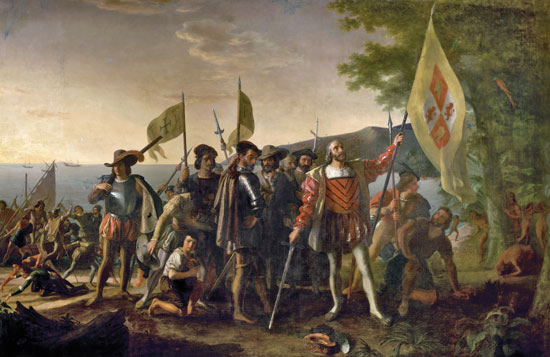
This is not necessarily a space for political writing. It’s not not a space for it either. But we still try to keep it apolitical in a bid to focus on writing and rhetoric and, increasingly, our own lives. Inevitably, however, there’s going to be crossover. Today’s blurring of the apolitical lines is spurred on by both my own complex heritage and a thirst for historical accuracy. I’m speaking of course about Columbus Day, 2020, and the Official White House proclamation thereof:
If you haven’t read the above, you should take a moment and sit with it. For some it no doubt seems like a breath of fresh air, returning to some sense of normalcy. I can see why some folks would have that perspective. To them, history isn’t a living thing, full of new discoveries and differing perspectives. They learned in school that Columbus set out to prove the earth was round and then settled the Americas and that was that. All this “new” history and closer looks at things seems overblown. And who wants to really look for bad things or dwell on unpleasantness?
The answer is everyone who isn’t looking at the world from a place of power (and their allies). Which, in America, is everyone who isn’t White. That’s a tough thing to read for a lot of folks, but I don’t put it down here as a jab at anyone for being born White but as a statement of fact. For a host of complex societal reasons, a lack of melanin and roots to Western Europe put one in a better position in America than any other cultural and cosmetic mix. From slavery to redlining, internment camps in our own backyard, to broken treaties and cultural eradication, the “miracle of American history and honor our founding [sic]” looks different to those in the minority.
It doesn’t come from a place of condemnation, either, but from a hope that we can do better. No one decrying Columbus Day hates America. In fact, we care enough about our nation to look back and see the bad spots. To acknowledge our progress has come at a price and that as we evolve as a country we want to learn from our past. To look back with rose-colored glasses and assure ourselves that everything was great and perfect and without fault washes away centuries of pain inflicted on non-white Americans (and White Americans who were the wrong type of White).
This mindset of burying one’s head in the sand is, of course, captured beautifully by Christopher Columbus and the take on him from the current White House. Despite the fact that Columbus did open up a trade route to the Caribbean for Spain, he “discovered” very little of what would become the USA and very little of the Americas overall. He did discover several native civilizations wearing gold who he was able to subjugate. A lot can and has been said about the cruelty with which Columbus overtook, enslaved and ultimately annihilated the “Indians” he encountered. But even leaving that aside, Columbus had a vision and scope only for the gold and slave trade found in the area he first landed.
Even when faced with contemporary evidence that he had landed on a “new” continent (Leif Erikson be damned), Columbus insisted it was India and he was successful in his quest for a new trade route (the “Fake News” cry of the time). Amerigo Vespucci, on the other hand, saw the new-to-Spain land for the possibilities it had. Rather than stubbornly insist that the continent was the other side of a known part of the world, Vespucci at least had the foresight to recognize a place “more densely peopled and abounding in animals than our Europe Asia or Africa, and, in addition, a climate milder and more delightful than in any other region known to us, as you shall learn in the following account.” And even if his letters paved the way for European settlement, at least he recognized the land for what it was. Hence why the whole mass is named after him and not Columbus.
So Columbus was wrong about where he landed, and stubbornly so, even in light of his contemporaries. He had a singular focus on gold and wealth. He used his power to subjugate and enslave the people he encountered and made their lives so miserable that the ones he and his men, hunting dogs and disease didn’t kill simply stopped reproducing. To put him above others as the “discoverer” of America is just silly. And to pretend like his exploration and impact were without consequence and devastation, something to be lauded, is willful ignorance.
History is easier when you don’t dig deeply. It’s nice and safe to imagine the cursory stories we get in kindergarten is all there is to it and we aren’t capable of committing atrocities against each other. But we are and have been for forever, and the only way to become better is to look at history honestly and condemn the darkness. Doing otherwise normalizes and celebrates the wrongs and the people that perpetrated them. Rather than run from these conversations we should celebrate the fact that we are at a point in history where we can openly discuss and examine our past in a naked and truthful way.
It’s ugly and painful and full of guilt, both misplaced and correctly laid, but if we don’t name it and talk about it we can never be better than it.
 The Barberry Writers